The enterprise case for one virtual care platform
Vendor sprawl is expensive in ways no single invoice shows. This page makes the consolidation case the way your committee will actually evaluate it — why change, why now, and why Teladoc Health.


Vendor sprawl is expensive in ways no single invoice shows. This page makes the consolidation case the way your committee will actually evaluate it — why change, why now, and why Teladoc Health.
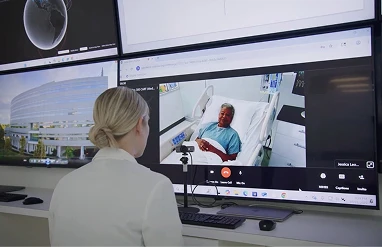
Each solution made sense when bought — a sitter camera, a stroke cart, a video tool. Now, each has its own contract, integration, security review, and workflow for clinicians. The visible cost is licensing; the real cost includes IT hours, trapped capital, siloed data, and clinicians toggling between incompatible tools. Fragmentation is a tax.
Virtual care playbook:
Staffing economics won't self-correct. Every quarter on the old care model compounds turnover, contract labor, and burnout costs that consolidation directly attacks.
AI is moving from pilots to standards of care. Systems on a consolidated platform activate it by software update; fragmented stacks face another procurement cycle just to start.
Federal and state modernization investment — including the rural transformation window — favors systems with an executable plan over systems still comparing vendors.
They fail after go-live. Here's what keeps them running.
Enterprise implementation: Implementation teams with experience deploying virtual care across hundreds of health systems.
24/7 technical support: A Technical Assistance Center provides around-the-clock support to keep programs running.
Proactive monitoring: Issues can be identified and addressed before they disrupt clinicians.
Ongoing business reviews: Regular reviews help identify opportunities to improve performance, expand adoption, and support new use cases.
Long-term partnership: Teladoc Health stays involved beyond implementation to help health systems continue getting value from their investment.

One enterprise platform for virtual care and AI · An EHR-integrated system living inside clinical workflows · A device* family that gains capability through software, so the investment compounds · A managed operating partnership with accountable outcomes · A governed AI layer with humans in the loop
A bundle of point solutions under one invoice · A sitter camera, a stroke cart, and a video app that don't talk to each other · Bolt-on AI wired into someone else's stack · Hardware that ages out when the roadmap changes · A vendor you only hear from at renewal
Consolidation ROI isn't one number — it's five levers pulling the same direction
Retire overlapping contracts and renewals.
One device family, upgraded by software.
Turnover, contract labor, and overtime relief.
Fewer transfers out, more specialty revenue retained.
One integration, one security review, one vendor to manage.
The truest proof of a platform decision is what clients do after making it: they expand. Hear from health systems on why they partner with Teladoc Health.
The consolidation case is strongest where resources are thinnest — and funding is finally on your side.

Consolidation isn't rip-and-replace. Most systems start with the sharpest need — nursing, safety, or specialty access — prove it, then migrate point solutions in phases as contracts sunset. The platform is patient. The clocks above are not.
Value lands across five levers: retired vendor contracts, hardware reuse, workforce savings, care kept in-system, and IT efficiency.
No. Consolidation runs in phases — start with one use case, migrate point solutions as contracts sunset, and retire hardware on your capital schedule.
Implementation follows a proven enterprise playbook with dedicated teams and defined milestones; from kickoff to first live program.
One contract instead of many, one integration instead of a dozen, one security review, one governance model, one fleet — and devices that gain capability by software instead of replacement.
Depth without a platform becomes another silo. Solo matches the workflow depth where it matters and adds what no point vendor can: an investment where every new use case makes the last one more valuable.
Start with the Tech Stack Complexity Assessment, then bring us your numbers — our team supports ROI modeling and business-case development as part of evaluation.
*Use of the word “device(s)” in this document refers to Teladoc Health telehealth products, not medical devices as defined in Section 201(h) of the FD&C Act.