
How to sleep better in summer: Tips for hot nights, late sunsets, and longer days
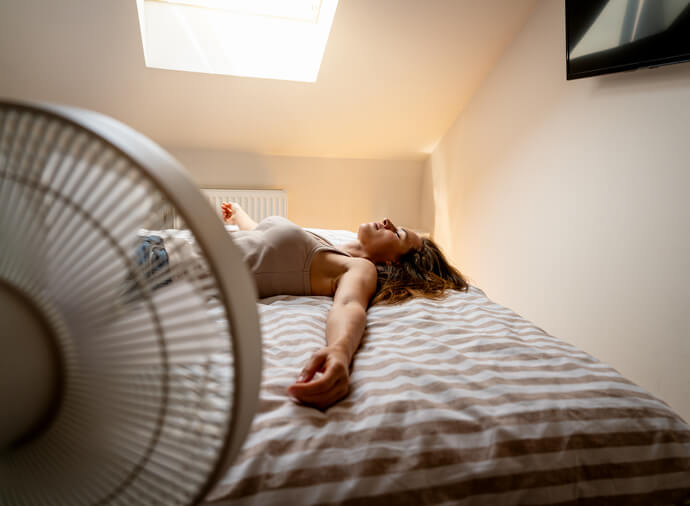
For most people, a room between 65°F and 67°F is perfect for falling asleep, according to the National Sleep Foundation. A warm room is just one possible culprit behind why you may toss and turn during the summer months. Later sunsets and changing routines may also interfere with your body’s natural sleep signals more than you might expect. The good news: A few targeted changes can help you combat these sleep challenges.
How summer can challenge your sleep
Your body must drop 1 to 2 degrees to signal to your brain that it’s time for sleep. A room temperature that’s warmer than the ideal range may make it difficult for your body temperature to drop and shift into sleep mode. As your body tries to cool itself, you may feel restless and unable to settle down.
Humidity is another factor that can impact your sleep. The ideal relative humidity for sleep is between 40% and 60%, according to researchers at the San Jose State Research Foundation’s Fatigue Countermeasures Laboratory. Depending on where you live, the humidity levels may be higher than this—especially during the summer. In Miami, FL, for instance, the average humidity later in the day is around 65% during June, July, August and September, according to the Florida Climate Center at Florida State University.
The longer summer days can also throw off your sleep. Your body produces the sleep hormone melatonin in response to darkness, according to the National Institutes of Health. When the sun begins to set, your brain starts getting the signal that it’s time for rest. The later that happens, the later your body gets these signals. In some parts of the contiguous United States, the sun might not set until after 9:00 PM at certain points of the summer.
Besides the heat and later daylight, having a more laid-back routine in summer can also disrupt your rest. Sleeping in can seem like a way to feel less tired, however, if you’re waking up later that also means you’re waiting until later to be exposed to light. That changes your body’s production of melatonin, which can throw off the body’s internal clock.
Age and medication can make it harder
The summer heat may impact older adults more than younger adults. Older adults don’t sweat as much as younger adults. That makes it harder to cool off, an important part of the body’s transition to sleep. Some medications such as certain antidepressants, like fluoxetine, can also interfere with sleep. If you’ve noticed you’re tossing and turning since starting a new medication, talk to your doctor.
Your summer sleep reset
If summer is getting in the way of your slumber, try these tweaks:
Cool your room and yourself
Pre-adjust the air. If you have an air conditioner, set it to somewhere between 60 and70 degrees around 30 minutes before you’re ready to turn in so it has time to work.
Air it out. If you don’t have AC, work with what you have. Open a window at night to let the cooler air in, but close it before the morning heat sets in. A well-placed fan can also go a long way.
Swap your sheets. While some companies may sell “cooling sheets” with a high price tag, independent testing by Wirecutter found that cotton percale and linen sheets are some of the most reliably cool and comfortable.
Take a cool shower before bed to help lower your body temperature. Reducing your body’s core temperature will set the stage for that natural drop needed for sleep onset.
Choose light, natural fabrics to sleep in; clingy or heavier fabrics can trap heat in.
Adjust the light
Block the sun. Blackout curtains can help you feel ready for bed if the sun wants to stay up later than you do.
Turn off your screens. Light from your phone or iPad signals for your brain to stay alert; powering down around an hour before bedtime can help you settle down.
Control what you can. If you’re home 1-2 hours before bed, set the tone by dimming the lights and turning off bright overhead lights.
Get some morning light. Exposure to natural light early in the day can help set your biological clock. Aim for at least 30 minutes of outdoor time. This triggers a response from your brain that controls the timing of brain chemicals like melatonin that will continue to impact you even at bedtime, according to research published in the journal BMC Public Health.
Stick to a routine
Keep it consistent. Your body is a creature of habit. Sticking to the same sleep and wake schedule can help you when it comes to feeling ready for rest.
Go screen-free. The blue light from screens suppresses melatonin, which is critical for sleep. Be sure to turn off all screens at least an hour before bedtime.
Read a book. Using the hour before bedtime for a quiet activity like reading can help you shift gears and slow down.
Write down worries. If your brain tends to race at bedtime, get in the habit of jotting down the things that are on your mind. You can rest easier knowing you’ll tackle them tomorrow.
Summer sleep challenges are common but manageable. By altering your sleep temperature and adjusting your routines, you may see improvements within a few days. Keeping a sleep journal or using a sleep tracking app like Sleep Cycle or your smartphone’s health app can help you identify patterns. If you continue to struggle with sleep, talk to your provider.
Frequently asked questions
Q: What is the best temperature for sleeping in summer?
A: For most people, a room temperature between 65°F and 67°F is ideal for sleep, according to the National Sleep Foundation. If you have air-conditioning, set it about 30 minutes before bed so the room has time to cool down.
Q: Does humidity affect sleep quality?
A: Yes. Researchers at the San Jose State Research Foundation’s Fatigue Countermeasures Laboratory found the ideal relative humidity for sleep is between 40% and 60%. Higher humidity—common in summer, especially in regions like the Southeast—can make it harder for your body to cool down and fall asleep.
Q: Why is it harder to fall asleep when it stays light outside?
A: Your body produces melatonin in response to darkness, according to the National Institutes of Health. When summer sunsets are delayed past 9 PM in some parts of the U.S., your brain receives the sleep signal later, pushing back the natural urge to feel tired.
Q: Can morning light actually help you sleep better at night?
A: Yes. Getting at least 30 minutes of light exposure early in the day helps set your biological clock by impacting brain chemicals like melatonin that influence your sleep timing hours later, according to research published in the journal BMC Public Health.
Q: Why do older adults struggle more with sleep in summer?
A: Older adults tend to sweat less than younger adults, which makes it harder for their bodies to cool down—a necessary step in the transition to sleep. Certain medications, including antidepressants, like fluoxetine, can also interfere with sleep and the body’s ability to regulate temperature.
Sources
- Caddick ZA, Gregory K, Arsintescu L, Flynn-Evans EE. A review of the environmental parameters necessary for an optimal sleep environment. Building and environment. 2018; 132: 11-20. doi: 10.1016/j.buildenv.2018.01.020
- Centers for Disease Control and Prevention. Heat and medications—Guidance for clinicians. Accessed June 17, 2026.
- Florida Climate Center. Office of the state climatologist. Relative humidity. Accessed June 17, 2026
- Harding EC, Franks NP, Wisden W. The temperature dependence of sleep. Frontiers in Neuroscience. 2019;13:336. doi:10.3389/fnins.2019.00336
- Irish LA, Kline CE, Gunn HE, Buysse DJ, Hall MH. The role of sleep hygiene in promoting public health: a review of empirical evidence. Sleep medicine reviews. 2014;22:23. doi:10.1016/j.smrv.2014.10.001
- Menezes-Júnior LAA de, Sabião T da S, Carraro JCC, Machado-Coelho GLL, Meireles AL. The role of sunlight in sleep regulation: analysis of morning, evening and late exposure. BMC Public Health. 2025;25:3362. doi:10.1186/s12889-025-24618-8
- National Library of Medicine, MedlinePlus Medical Encyclopedia. Aging changes in vital signs. Accessed June 17, 2026.
- National Sleep Foundation. How to refresh your bedroom for spring. Accessed June 17, 2026.
- National Sleep Foundation. Is your bedroom too warm? It could be affecting your sleep. Accessed June 17, 2026.
- Savage RA, Zafar N, Yohannan S, Miller JMM. Melatonin. In: StatPearls. StatPearls Publishing; 2026. Accessed June 17, 2026. http://www.ncbi.nlm.nih.gov/books/NBK534823/
- Wichniak A, Wierzbicka A, Walęcka M, Jernajczyk W. Effects of antidepressants on sleep. Current Psychiatry Reports. 2017;19(9):63. doi:10.1007/s11920-017-0816-4
Was this article helpful?
Sign up to unlock your health, your way at no cost to you.
This content is not intended to be a substitute for professional medical advice, diagnosis or treatment. Always seek the advice of your physician or other qualified health provider with any questions you may have regarding a medical condition.
You may not be eligible for all services. Log in to view the benefits included in your plan.