
The secrets to making habits stick

We are creatures of habit.
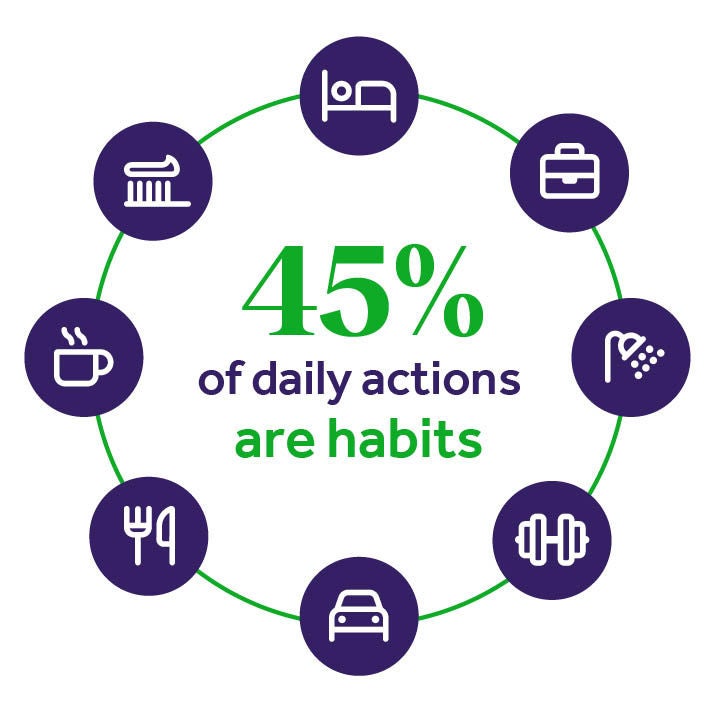
Almost half of what we do as we go about our daily lives is a habit. It’s bathing, dressing, eating, commuting, doing parts of our jobs, exercising and so on. You don’t really think about it—you just do it. Have you ever arrived home from work and could not remember a moment of your commute? It’s because it’s a habit. These actions are filed away in your brain to be used on repeat so you don’t have to think much about them.
Breaking or making new habits requires conscious decisions. In theory, it sounds simple: decide to change or make a habit and it’s done.
Unfortunately, it’s not as easy as it seems. Your brain files actions away as patterns. The action-reward molecule dopamine kicks in as motivation when actions start to become more familiar.
How many times do you have to do something to make it a habit? For your brain to admit it’s an action worth keeping? Anywhere from a few weeks to several months—the average is 70 days. That’s quite a challenge, though there are techniques that can help get you there faster.
Hidden triggers
One of the fastest ways to create a habit is to find something that can act as a trigger—reminding you to do it. Simple is key. Choose something that happens without your control and make it work for you.
Example: You want to practice deep breathing. Take one deep breath (or more) every time you stop at a red light while driving. Your trigger becomes the red light.
Habit stacking
Similarly, habit stacking is a way of capitalizing on what you already do. Again, keep it simple—one action that can be wedged in with your other activities.
Example: You want to take a vitamin every morning. Write down the series of actions you automatically take each day. Make coffee, make toast, pack lunch, eat, start the dishwasher. Stack taking your vitamin into this sequence and before you know it, it will be a habit.
Environmental anchors
When you see a plate of cookies, you can’t help but take one and eat it. That plate is an environmental anchor for our collective cookie-eating habit. Our minds react to visual cues more than you think.
Example: You want to drink more water during the day. Keep a refillable water bottle on your desk or in plain sight as a reminder. It works.
Doorframe technique
You come and go through doors daily. Use this transition to your advantage by attaching a desired habit to it. Again, simple is best.
Example: You want to stop hunching your shoulders and slouching. Use each doorframe you pass through as a reminder to stand up straighter and relax your shoulders.
Use these techniques to help you form good habits in your own life. They may work faster than you think.
You may not be eligible for all services. Log in to view the benefits included in your plan.
Sources
Psychology Today. The neurobiology of habits. Published June 2025. Accessed May 18, 2026.
Psychology Today. How your environment shapes your habits. Published March 2025. Accessed May 18, 2026.
Was this article helpful?
Sign up to unlock your health, your way at no cost to you.
This content is not intended to be a substitute for professional medical advice, diagnosis or treatment. Always seek the advice of your physician or other qualified health provider with any questions you may have regarding a medical condition.
You may not be eligible for all services. Log in to view the benefits included in your plan.