
Why routines work for you

“Routine” has a bad reputation.
Things considered “routine” aka “run-of-the-mill” or “regular” could be seen as possibly boring. But when it comes to functions that get you through the day—walking the dog, making meals, doing school drop-off—we would be nowhere without routine.
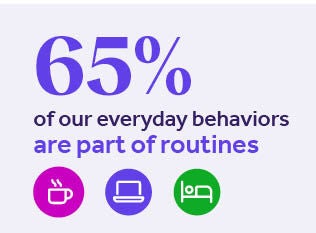
We’re on autopilot for about two-thirds of our actions each day. In some ways, it could be considered that we are sleepwalking through our lives. However, that couldn’t be further from the truth.
Free your mind
We make thousands of decisions a day. If it was possible to free yourself from even a few of these,2 wouldn’t it be a relief? It could potentially lighten your mental load and reduce your stress level.3
This is where routines become useful. By creating a series of actions you take without much thought, you’re freeing up your mind. Imagine what you could do with a few free moments.
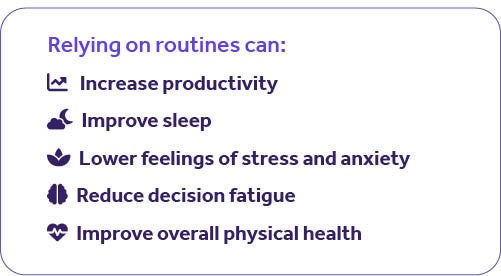
Freeing up your mental capacity is good for your mental health.
How to build routines
Choosing to follow routines is a little more deliberate than building a habit, which is done automatically. That’s why when people talk about routines, they are tied to specific actions—morning routines, workout routines, bedtime routines, etc.4,5 But how do we get there? With intention.
Pick an area of focus: Such as bedtime, healthy eating, managing stress or exercise.
Stack small actions: Choose what actions will go into your routine. For example, if you’re managing stress, your routine’s actions may include finding a quiet space, practicing breathing exercises, listening to soothing music and writing yourself words of encouragement.
Trust the process: After a short period of consciously taking actions, it will become easier. You may actually look forward to the routine.
Even small consistent steps add up to relief for your mental load, allowing you to feel better mentally and physically.
Sources
- Gardner B, Rebar AL, Forbes S, et al. Scientists say most of what you do each day happens on autopilot. Psychol Health. Published March 6, 2026. Accessed June 16, 2026.
- Krockow EM. How many decisions do we make each day? Psychology Today. September 27, 2018. Accessed June 16, 2026.
- UCLA Health. How a daily routine can boost your mental health. March 11, 2026. Accessed June 16, 2026.
- Northwestern Medicine. Healthy habits to strengthen your daily routine. Updated March 2026. Accessed June 16, 2026.
- Murray G, Gottlieb J, Swartz HA. Maintaining daily routines to stabilize mood: theory, data, and potential intervention. Can J Psychiatry. 2021;66(1):9-13. Accessed June 16, 2026.
- Fujiwara H, Tsurumi K, Shibata M, et al. Life habits and mental health: behavioural addiction, health benefits of daily habits, and the reward system. Front Psychiatry. 2022;13:813507. Accessed June 16, 2026.
Was this article helpful?
Sign up to unlock your health, your way at no cost to you.
This content is not intended to be a substitute for professional medical advice, diagnosis or treatment. Always seek the advice of your physician or other qualified health provider with any questions you may have regarding a medical condition.
You may not be eligible for all services. Log in to view the benefits included in your plan.