Smarter virtual sitting for safer patients and leaner hospital operations
Patient falls cost U.S. hospitals an estimated $50 billion a year*
Clarity, our AI suite, continuously analyzes patient movement, behavior, and environmental signals to flag fall risk and potential injury before an incident occurs. Proactive alerts. Faster response. Better outcomes — on the same device your team already uses.
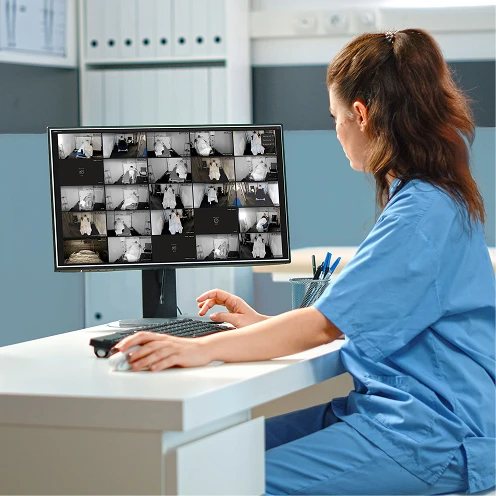
Virtual sitting — also called virtual patient monitoring or vSitting — uses remote safety monitors and AI-enabled technology to watch over at-risk patients without requiring a staff member to be physically present in the room. A single remote monitor can observe multiple patients simultaneously, alerting bedside staff the moment intervention is needed. It's a proven, cost-effective alternative to traditional one-to-one bedside sitters, and a critical tool for hospitals facing staffing shortages and rising patient safety demands.
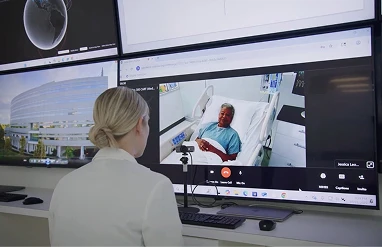
Teladoc Health's virtual sitting solution runs on the same SOLO platform device used for virtual nursing and clinical consultations. A remote safety monitor views a live feed of the patient room and can communicate directly with the patient or trigger an alert to bedside staff — all without disrupting other care activities happening on the same device. Clarity, our AI suite, adds an additional layer by continuously analyzing patient movement and behavior to identify fall risk before an incident occurs.
Most virtual sitting vendors offer a standalone monitoring application — a single tool for a single purpose. Teladoc Health's virtual sitting runs on SOLO, so it operates alongside virtual nursing, clinical consultations, and AI-enabled monitoring on the same device and platform. That means no additional hardware, no separate vendor relationship, and no siloed program to manage. It also means your virtual sitting investment today builds toward a broader virtual care capability tomorrow.
Hospitals using virtual sitting report meaningful improvements across patient safety, staff efficiency, and operational cost — including reduced patient falls and injuries, lower spending on unreimbursed sitter positions, the ability to monitor multiple patients with fewer staff, faster response times when patients need intervention, and more time for bedside nurses to focus on direct clinical care.
Yes. Virtual safety monitoring and virtual clinical consultations — including nursing, specialist consults, and patient education — can run concurrently on the same SOLO device without either workflow disrupting the other. This is one of the key advantages of a platform approach over point solutions.
*Source: Journal of the American Geriatrics Society, "Medical Costs of Fatal and Nonfatal Falls in Older Adults.”