We have more health data than ever before, yet people managing chronic conditions are still asked to do too much. Whether it’s managing multiple apps with siloed data or having to repeat their health history with a new provider, people are often left to coordinate their own care.
Recent advances in AI are changing that. Over the last 12-24 months, AI has made huge leaps. The benchmarks for AI accuracy, reliability and capability have progressed to where it’s capable of being used in more complex healthcare scenarios.
At Teladoc Health, we believe we can use AI to boldly do the work it has evolved to do: ingest large amounts of data from multiple sources and continuously monitor for patterns that help determine whether people are getting healthier. No care provider, no matter how skilled, has the ability to continuously monitor millions of data points across vast populations to understand how their health is changing each and every day.
AI is helping to close that gap. It’s not replacing care providers, but by doing work behind the scenes, it’s enabling providers to remove some of the burden from the people seeking care and focus on helping them live their healthiest life.
How AI can help improve health between touch points with a clinician
For decades, healthcare has measured activity. Actions matter, but to patients and plan sponsors, they’re not the bottom-line results. What matters most to them is whether a person is achieving better health outcomes. Historically, answering that question has been difficult.
Health happens every day. It’s in that time where small behaviors make a big difference.
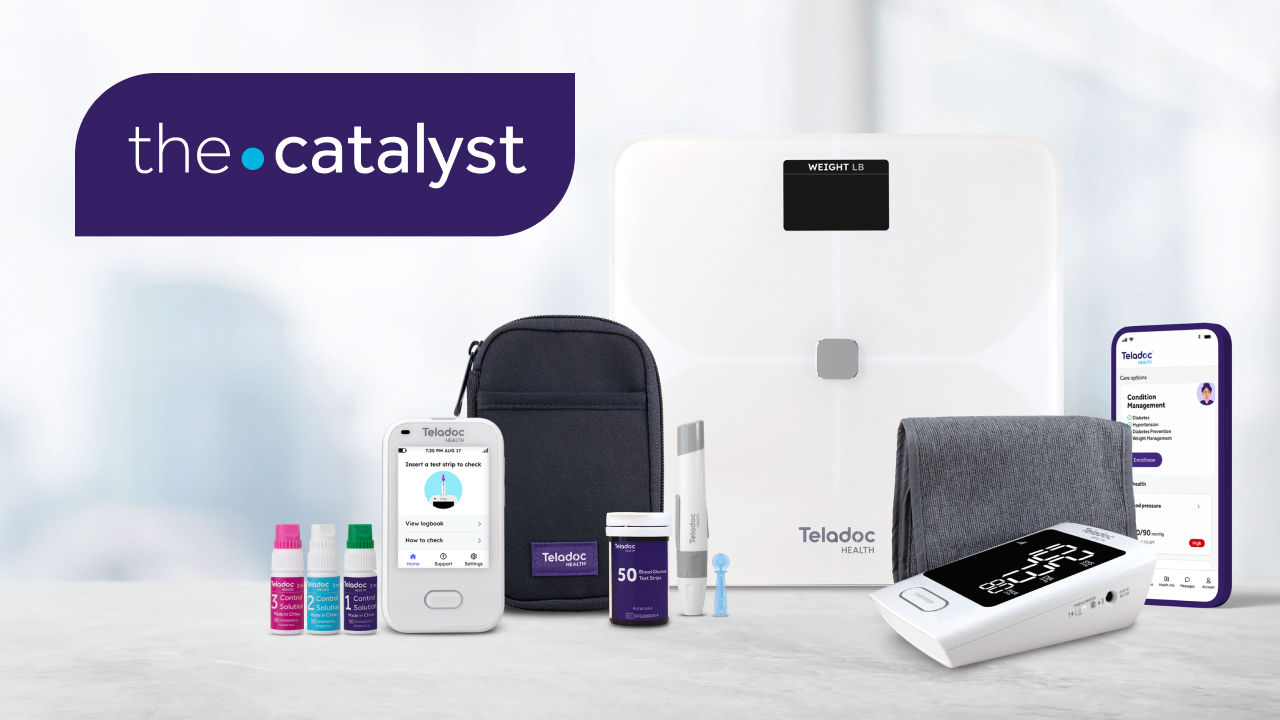
AI enables us to interpret signals in these moments and compare them with individuals’ goals. We can monitor behaviors, track people’s progress and ensure people don’t fall through the cracks. Using connected device readings, lab results and other health indicators (including social determinants of health), AI provides a more complete picture of someone’s health—along with their willingness to engage and ability to change behaviors—to support the ultimate goal of better health, however that person defines it.
Turning health signals into timely action
Healthcare doesn’t lack interventions. The opportunity is knowing which intervention is most likely to help a specific person at a specific moment and how to engage them.
That’s where AI has become transformative to what we’re doing at Teladoc Health.
With Teladoc One, intelligence works behind the scenes to surface signals to our multidisciplinary care teams to act on. The combination of clinical, multi-source data and AI allows us to monitor entire populations while determining each individual’s “impactability.”
This formula helps us recognize who’s at risk, who’s reachable and what’s treatable, and it allows the care team to focus on the highest-impact interventions. Whether that’s a medication adjustment, provider consultation or other action, support is in place to intervene, track whether the patient followed through on the intervention and monitor the impact.
AI is doing heavy lifting, but the result is a human-based care team informed and ready to offer personalized support. In a 2025 pilot, 53% of Teladoc Health cardiometabolic members identified as high-risk showed clinical improvement through proactive care team outreach.
This combination of connected data, clinical teams and measurable follow-through puts Teladoc Health in a distinctive position. We can advance what AI does in healthcare while helping raise the standard for how it’s governed.
Why responsible healthcare AI requires firm boundaries
The debate has shifted from whether AI belongs in clinical care to how far it should extend and who is positioned to govern it. As the healthcare system asks AI to do more, the higher the standards must be for how it’s used. At Teladoc Health, we can be bold in applying AI because we are equally rigorous about the boundaries around it.
Safety, reliability, clinical quality and bias reduction must be built into how AI is developed, evaluated and used. Like any clinical tool, we hold AI to high standards, and it doesn’t get validated once and deployed. We’re constantly evaluating our models, and AI itself takes part in that oversight, continuously monitoring its own performance against real-world outcomes and surfacing where the model needs to improve.
Our longitudinal data positions us to help fill existing evidence gaps by validating AI against real clinical encounters. Also, because expanding the responsible use of AI will require healthcare organizations to address questions involving licensure, medical liability and clinical oversight, Teladoc Health is uniquely suited to be part of those conversations.
For more than 20 years, people have come to Teladoc Health expecting a high standard of clinical quality. How clinical quality is defined will evolve alongside AI, and our history gives us an advantage in shaping it. That responsibility is why we’re using AI to raise the standard with Teladoc One. By continuously monitoring people’s health and surfacing opportunities for earlier action, AI can do something no human care team could do manually at scale. Instead, they can focus their expertise on where it can have the greatest impact.
That’s the promise of Teladoc One: AI taking on more of the work behind the scenes, so our care teams can better understand each person, act at the right moment and help more people achieve better health with less burden on their shoulders.