
10-minute no-equipment workout (beginner-friendly)
Key points
- Build total-body strength in 10 minutes with no equipment
- Work for 30 seconds, rest for 15, repeat moves three times and enjoy a cool-down
- Go at your own pace, focus on form and check with your doctor first
Think you need a gym membership or a free hour to build strength? You don’t. In just 10 minutes, you can work your whole body using nothing but your own body weight. Do it at home, in a hotel room or anywhere you can find a little space. Over time, getting stronger can make everyday tasks, like carrying groceries or climbing stairs, feel a lot easier.
This workout is made with beginners in mind, so there’s no need to rush. Take it at your own pace and focus on good form over speed. If a move feels like too much, make it smaller or take a short rest. That’s part of the process. As you get stronger, you can add more reps or slow down each move to make it harder. Before you begin, talk with your doctor about starting a new workout plan. This is especially important if you have a health condition or an injury, or if it’s been a while since you’ve exercised.
This workout has four exercises.
Squats
Push-ups
Bridge with leg extension
Plank with alternating 1-arm reach
Do each one for 30 seconds, then rest for 15 seconds. When you finish all four, that’s one round. Repeat for a total of three rounds. At the end, do a 1-minute cool-down.
Squats
Squats work your hips, thighs, glutes and core. Strong muscles in these areas help you move with more ease and stay steady on your feet. Stand with your feet about shoulder-width apart, then lower your hips back and down like you’re sitting in a chair. Press through your heels to stand back up.
Modify: Can’t go all the way down yet? Lower just part of the way. Your range will grow as you get stronger. Not sure about balance? Rest your hand or fingertips on a sturdy chair or wall.
Push-ups
Push-ups work your chest, shoulders, arms and core. Start on your hands and knees, then step your feet back so your body forms a straight line from head to heels. Bend your elbows to lower your chest toward the floor, then press back up.
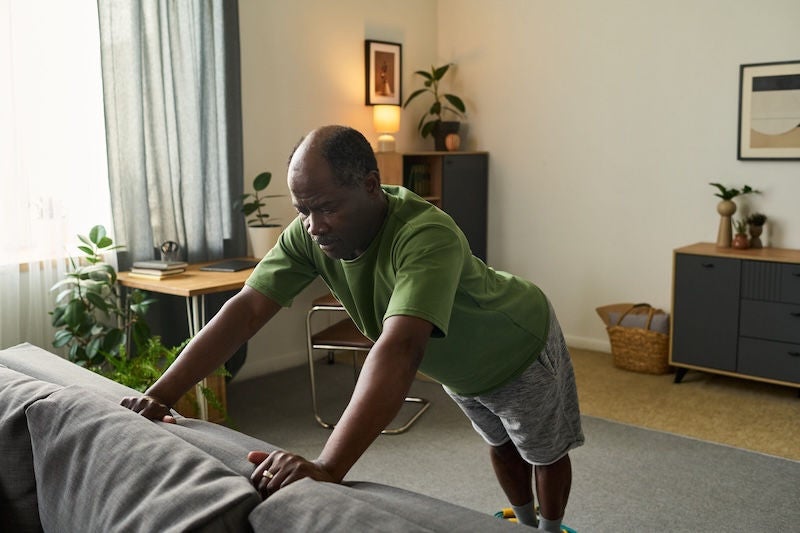
Modify: Does a push-up feel difficult? Drop to your knees and keep your body in a straight line from head to knees. Or place your hands on a sturdy surface, like a countertop, a couch or a wall. The higher your hands, the easier the move. As you get stronger, lower your hands a little at a time.
Bridge with leg extension
This move helps build the muscles that keep your lower body steady. You’ll likely feel it in your glutes, hamstrings (the backs of your thighs), hips and core. Lie on your back with your knees bent and feet flat on the floor. Squeeze your glutes and lift your hips off the ground. Then lift one leg, lower it and switch sides.
Modify: Is the leg lift too hard? Lift your foot just a little off the floor. You can also skip the leg lift and do only the bridge. When that feels easy, add the leg lift back in.
Plank with 1-arm reach
This move works your core, shoulders, arms and glutes. It also trains your body to stay steady while you move. Start on your hands and toes with your hands under your shoulders. Your body should form a straight line from head to heels. Keep your hips level and reach one arm straight out in front of you. Place it back down, then reach with the other arm. Keep your belly tight and move slowly.
Modify: Is it hard to stay steady? Spread your feet wider apart. That gives you more support. You can also drop to your knees or place your hands on a countertop or sturdy chair. If reaching feels like too much, hold the plank without reaching, or just lift your hand a few inches off the floor.
Cool down
Standing quad stretch: Stand tall. Bend one knee and gently pull your foot toward your glutes. Hold on to a wall or chair for balance if you need to. Switch sides.
Chest stretch: Clasp your hands behind your back. Gently lift them and open your chest.
Overhead reach: Reach both arms up high and take a few deep breaths.
FAQs
Do I need to warm up?
A short warm-up is a good idea. It gets your blood flowing and helps your body feel ready to move. You don’t need anything fancy. Try marching in place, rolling your shoulders, or doing a few easy arm circles for about a minute. You can also use your first round as a warm-up by moving slowly and taking it easy.
How often should I do this workout?
Try it two to three days a week, with a rest day in between. The Centers for Disease Control and Prevention (CDC) recommends strength activities that work all your major muscle groups at least two days a week. If you’re new to exercise, start with one or two days and add more as you feel ready.
What if a move feels too hard?
That’s OK. Every move can be made easier. Do a smaller version, use a wall or sturdy chair for support, or take a short rest. If something hurts (not just feels like hard work), stop and talk with your doctor.
Main takeaway
You don’t need a gym or a lot of time to get stronger. With just 10 minutes and your own body weight, you can build a habit that supports your strength and makes daily life easier. Start at your own pace, focus on good form, and build from there.
Sources
Centers for Disease Control. Physical Activity Guidelines for Americans 2nd edition. Accessed October 29, 2026.
Was this article helpful?
Sign up to unlock your health, your way at no cost to you.
This content is not intended to be a substitute for professional medical advice, diagnosis or treatment. Always seek the advice of your physician or other qualified health provider with any questions you may have regarding a medical condition.
You may not be eligible for all services. Log in to view the benefits included in your plan.