
What women want and need from healthcare

Women have a lot on their plates.
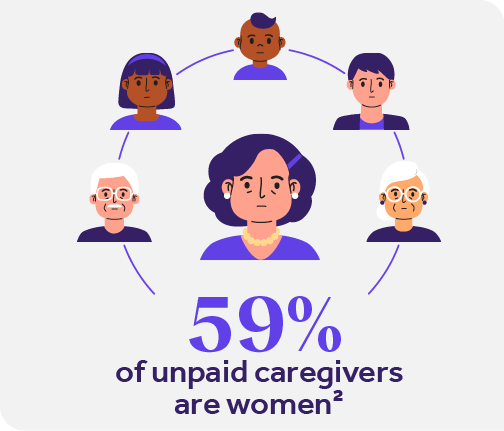
Careers and relationships fight for priority status. In most cases, women are the go-to parent, the manager of the family home and activities. And they’re the first call when parents or elderly family members need help. It's a lot to juggle.
But who should take priority, especially when it comes to health needs? They should.
There’s a dizzying array of ways women should take care of themselves, starting with prioritizing health and well-being. This includes eating well, sleeping well and getting regular physical activity. It also means managing stress, practicing mindfulness, finding joy and more. But that’s just the start.
Consider mental health
Is it any wonder women experience high rates of emotional distress, depression, anxiety, stress and burnout?2 Recognizing symptoms can be hard. Actions that can keep you in touch with your feelings include:
- Taking personal time (self-care).
- Sharing thoughts and feelings in a journal or with a licensed counselor.
- Developing a meditation or mindfulness practice.
The phases of life
Women go through distinct physical phases of life. Each requires specific preventive healthcare. Screening and counseling, including well-woman and reproductive care, are targeted depending on one’s age and stage. Some broad guidelines to follow:
- Adolescence (19 and under) A family care provider, or pediatrician, can offer support and guidance. Topics include menstruation, general well-being, age-appropriate vaccinations and sexual health.
- Early adulthood (20s-30s) A primary care provider or gynecologist can assess general health and risk factors. Focus is on sexual health, breast and cervical cancer screenings, birth control and age-appropriate vaccinations.
- Perimenopause (40s) A primary care provider or gynecologist can offer guidance on screenings and well-woman care. This includes breast, cervical and colorectal cancer screenings, skin checks, cholesterol and A1c tests and more.
- Menopause and postmenopause (50s-plus) A primary care provider, gynecologist or menopause specialist can address the above screenings. Discussions may also include bone density, mobility and memory assessments, sleep disorders and age-appropriate vaccines.
Be your own best health advocate
Women’s health concerns should be a priority for proper diagnosis and treatment. Sadly, gender bias exists everywhere, even in healthcare. Medical “gaslighting” is a real thing. It happens when a healthcare provider discounts a patient’s complaints. They may make them feel it’s all in their head. To prevent this from happening, it helps to be prepared for medical appointments. Consider:
- Bringing a journal documenting your symptoms.
- Researching what you are experiencing. Be familiar with the terms and be able to express your concerns.
- Preparing a short list of questions for your provider.
- Asking a friend to join you for support, help take notes and observe.
Women’s healthcare affects us all.
You may not be eligible for all services. Log in to view the benefits included in your plan.
Source
Harvard University. Healthy Living.
https://www.harvard.edu/in-focus/healthy-living/
Accessed April 6, 2026. [harvard.edu]Jain, Shaili, MD. Navigating the Mental Strain of Gendered Caregiving. Psychology Today. March 18, 2025.
https://www.psychologytoday.com/us/blog/the-aftermath-of-trauma/202503/navigating-the-mental-strain-of-gendered-caregiving
Accessed April 6, 2026. [psychologytoday.com]American Academy of Family Physicians. American Family Physician, Vol. 103, No. 4 (February 15, 2021).
https://www.aafp.org/pubs/afp/issues/2021/0215/p209.html
Accessed April 6, 2026. [aafp.org]Godman, Heidi. What to Do About Medical Gaslighting. Harvard Health Publishing. April 1, 2024.
https://www.health.harvard.edu/staying-healthy/what-to-do-about-medical-gaslighting
Accessed April 6, 2026. [health.harvard.edu]
Was this article helpful?
Sign up to unlock your health, your way at no cost to you.
This content is not intended to be a substitute for professional medical advice, diagnosis or treatment. Always seek the advice of your physician or other qualified health provider with any questions you may have regarding a medical condition.
You may not be eligible for all services. Log in to view the benefits included in your plan.